Diabetes Research Report
Yoga Research Foundation
A six-week intensive Diabetes Mellitus (DM) management course was conducted by Yoga Research Foundation at Ganga Darshan, Munger, from 28th April to 9th June 2002 under the guidance of Swami Niranjanananda Saraswati. The research report is presented here.
Aim
The aim of this research project is to scientifically assess the efficacy of the therapeutic technique to control diabetes mellitus as advocated by Swami Satyananda Saraswati.
Purpose
The need was felt to undertake this project because the incidence of DM in the Indian population is increasing in epidemic proportions. Insulin resistance is the central problem with Cardiovascular Dysmetabolic Syndrome (CDS). Yoga has been quite effective in controlling not only the blood sugar levels but also the other risk factors of CDS. Swami Satyananda originally conceived a therapeutic method for DM combining ancient hatha yoga and raja yoga practices. He experimented with this method and obtained excellent results. The need was felt to bring this technique into the limelight once again for the benefit of suffering humanity.
Method
Fifteen subjects were accepted for this study using the following selection criteria:
- Diabetes type II – NIDDM
- Absence of diabetic nephropathy
- Absence of major diabetic cardiovascular, ophthalmic or other complications
- Absence of any major systemic disorder that could limit yogic management
- Motivated for yogic management
On admission the subjects filled out questionnaires which collected general information and information about health, lifestyle, diet and current treatment. They underwent a clinical examination by the ashram doctor. Their yoga training started from the second day. The yoga practices consisted of:
- Shatkarmas: poorna shankhaprakshalana and 30 consecutive days of laghoo shankhaprakshalana
- Asanas: beginners, intermediate and advanced asanas, and their counter poses, mainly working on manipura chakra
- Pranayamas: balancing and cooling pranayamas
- Pratyahara and dharana practices
Other practices included kirtan and chanting, brisk walking and cleaning seva. In addition subjects attended satsang twice a week and lectures once a week.
Each subject followed the ashram's disciplined lifestyle. There were no dietary restrictions except that the tea was without sugar and the subjects were requested to avoid sweet foods as much as possible. On the eighth day, the day of poorna shankhaprakshalana, all medication was stopped and gradually restarted according to individual need.
At the end of six weeks each subject was given advice on ongoing medical treatment and a personal sadhana to practise regularly at home. All subjects were requested to correspond with the ashram once every three months for follow-up advice. After twelve months, a continuing yoga education (CYE) and reassessment course of one week's duration is planned. The total duration of the study is expected to be five years.
Parameters
Different parameters were studied at regular intervals throughout the six week period.
- Parameters studied before the training period and then once a week were:
- Blood sugar while fasting (F) as well as two hours after lunch (PP), using a glucometer
- Medication used
- BP, using an electronic measuring device
- Body weight, using a solar weighing scale
- Waist and hip circumference, using a measuring tape
- Parameters studied pre and post training period:
- Lipid profile
- Micro albuminuria
During the study period of five years the parameters will be monitored at the following frequency:
- Blood sugar F and PP: once a month
- HbA1c, body weight, BP, medication, symptoms and regularity of yoga: once every three months
- Lipid profile, micro albuminuria, lifestyle: once a year
Data and inferences
A. Characteristics of the sample
- Out of 15 subjects, 11 were male and four were female.
- Ten subjects were vegetarian, one was non-vegetarian and four were occasionally non- vegetarian.
- As shown in Table 1, ages ranged from 30–65 years with a mean age of 48.53 years.
- The duration of diabetes ranged from 1–20 years with mean of 6.88 years.
- BMI ranged from 17.25–31.62 kg/m2 with mean of 25.16 kg/m2. Three had BMI>28kg/m2.
- On arrival, the initial test result of fasting blood glucose was in the range of 93–412 mg% with a mean of 213 mg%. Post lunch blood glucose was in the range of 116–550 mg% with a mean of 273.3 mg%.
- On arrival systolic BP was in the range of 104–160 mm of Hg with a mean of 131.8 mm of Hg and diastolic BP was in the range of 65–99 mm of Hg with a mean of 81.93 mm of Hg. Four were on anti-hypertensive medication and one was an undiagnosed hypertensive.
- Lipid profile showed cholesterol in the range of 150–307.4 mg % with a mean of 208.26 mg %, HDL in the range of 24–75 mg% with a mean of 41.54 mg%, LDL in the range of 80–207.5 mg% with a mean of 126.97 mg%, and triglycerides in the range of 65–353 mg % with a mean 172.15 mg%.
| Parameter | Range | Median | Mean |
|---|---|---|---|
| Age in years | 30-65 | 50 | 48.53 |
| Duration of DM in years | 1-20 | 5.5 | 6.58 |
| BMI in kg/square meter | 17.25-31.62 | 24.13 | 25.16 |
| Bl. Glu. F in mg% | 93-412 | 201 | 213 |
| Bl. Glu. PP in mg% | 116-550 | 325 | 273.3 |
| Systolic BP in mm of Hg | 104-160 | 129 | 131.8 |
| Diastolic BP in mm of Hg | 65-99 | 82 | 81.93 |
| Serum cholesterol in mg% | 150-307.4 | 200.7 | 208.26 |
| HDL in mg% | 24-75 | 42.6 | 41.54 |
| LDL in mg% | 80-207.5 | 125 | 126.97 |
| Serum triglyceride in mg% | 65-353 | 140 | 172.15 |
| Allopathic for DM | 9 |
| Other drug for DM | 2 |
| No drug for DM | 4 |
| Allopathic for HBP | 4 |
As shown in Table 2, nine were on allopathic medication, two on other medication and four were not taking any medication.
| Bad family h/o DM | 3 |
| Family h/o DM | 6 |
| No family h/o DM | 6 |
| Family h/o HBP | 3 |
| No family h/o HBP | 12 |
As shown in Table 3, nine subjects had a family history of DM. Of these, three had a very bad family history (more than one family member having DM). Three subjects had a family history of high BP.
| HBP | 5 |
| Depression | 2 |
| Hysterectomy | 2 |
| Past h/o peptic ulcer | 1 |
| Cervical spondylosis | 1 |
| Hypothyroid | 1 |
As shown in Table 4, four subjects had high BP and one was detected as hypertensive. Two had depression, two had undergone hysterectomies, one had a past history of peptic ulcer, one had cervical spondylosis and one had hypothyroidism.
| Blood Glucose Fasting | 1st day | PrePSP/7 | AftPSP/9 | 15th day | 22nd day | 29th day | 35th day | 42nd day |
|---|---|---|---|---|---|---|---|---|
| Range | 93-412 | 93-389 | 76-312 | 81-293 | 93-272 | 91-345 | 80-220 | 91-207 |
| Median | 201 | 148 | 147 | 123 | 140 | 144 | 145 | 139 |
| Percentile-0.25 | 151 | 119 | 111.5 | 102.5 | 102.5 | 112 | 122.5 | 117 |
| Percentile-0.75 | 247 | 212.5 | 205.5 | 163 | 188.5 | 172.5 | 160.5 | 159 |
| Mean | 213 | 175.67 | 157.47 | 143.87 | 151.53 | 155.93 | 145.8 | 140.8 |
| Subjects with normal value | Nil | 1 | 3 | 6 | 5 | 4 | 3 | 4 |
| Subjects on medication | 9 | 8 | Nil | Nil | 2 | 1 | 2 | 11+2on half |
| Blood Glucose PP | 1st day | PrePSP/7 | AftPSP/9 | 15th day | 22nd day | 29th day | 35th day | 42nd day |
| Range | 116-550 | 116-518 | 116-550 | 138-536 | 155-576 | 134-346 | 127-518 | 135-448 |
| Median | 325 | 181 | 250.5 | 173 | 211 | 185 | 233 | 214 |
| Percentile-0.25 | 232.5 | 156 | 196.75 | 149.5 | 179 | 161 | 182 | 172 |
| Percentile-0.75 | 362.5 | 240.5 | 294.25 | 248.5 | 265.5 | 276.5 | 313 | 257 |
| Mean | 273.3 | 222 | 244.1 | 230.93 | 243 | 217.13 | 250.87 | 228.4 |
| Subjects with normal value | 1 | 1 | 2 | 1 | Nil | 1 | 1 | 1 |
| Subjects on medication | 9 | 8 | Nil | Nil | 2 | 1 | 2 | 11+2on half |
Explanatory note: 'Range' shows the lowest and highest readings. 'Median' shows the middle reading. For example, in a sample of 15 readings arranged in ascending order, the eighth reading is the median. It is same as percentile 0.5. Percentile 0.25 and 0.75 are the readings at the first and last quarters. In the above example, they are the fourth and the twelfth readings. Mean expresses the arithmetic mean or average.
B: Results of yoga training
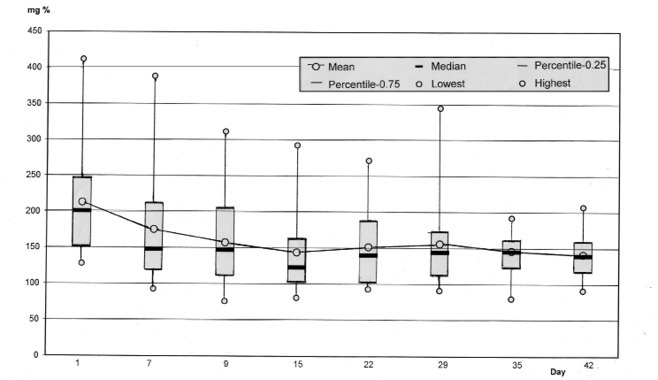
As shown in Table 5 and in Figures 1 and 2, a weekly study of blood glucose levels showed the best results on day 15. The practice of poorna shankhaprakshalana took place on day 8, followed by a very light diet (in quality, not in quantity) for one week (up to day 15). In addition, the de-stressing effects of the ashram environment and the continuing effects of recently stopped medication could explain the effect on blood glucose levels. This indicates that control of diet is very important in the management of DM.
Fig 1. Effect of Yoga on Fasting Blood Glucose in NIDDM
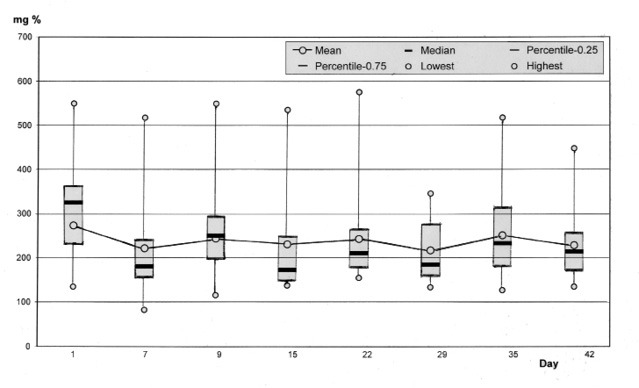
Fig 2. Effect of Yoga on PP Blood Glucose in NIDDM
| Fasting Blood Glucose | ||||||||
|---|---|---|---|---|---|---|---|---|
| Bl.gl.mg% | Day 1 | Day 7 | Day 9 | Day 15 | Day 22 | Day 29 | Day 35 | Day 42 |
| <111 | 2 | 2 | 3 | 6 | 5 | 4 | 3 | 4 |
| 111-200 | 5 | 8 | 7 | 7 | 7 | 9 | 11 | 10 |
| 201-300 | 6 | 4 | 4 | 2 | 3 | 1 | 1 | 1 |
| 301-400 | 1 | 1 | 1 | 0 | 0 | 1 | 0 | 0 |
| >400 | 1 | 0 | 0 | 0 | 0 | 0 | 0 | 0 |
| PP Blood Glucose | ||||||||
| <140 | 2 | 2 | 2 | 1 | 0 | 1 | 1 | 1 |
| 140-200 | 1 | 6 | 2 | 7 | 6 | 7 | 5 | 6 |
| 201-300 | 4 | 4 | 7 | 4 | 7 | 6 | 4 | 6 |
| 301-400 | 6 | 2 | 3 | 1 | 1 | 1 | 4 | 1 |
| 400-500 | 0 | 1 | 0 | 1 | 0 | 0 | 0 | 1 |
| >500 | 2 | 0 | 1 | 1 | 1 | 0 | 1 | 0 |
As well as showing the frequency distribution, Table 6 also shows how the blood sugar gradually improved. The number stands for the number of subjects having blood sugar in that particular range. As one moves from left to right within the table, the number of subjects in the higher blood sugar range decreases and they move into a lower blood sugar range.
Table 7 shows the comparison between each individual's pre blood glucose level and the mean level during the six-week training period. Out of the 15 subjects, four were benefited to a lesser extent (marked with asterisk in Table 7). Of these, two could not practise yoga regularly due to illness, one turned out to be an insulin dependent diabetic (IDDM) and for the last one no reason has been found as yet.
During the weekly monitoring it was found that BP had a tendency to rise. The suspected reasons are:
- Use of salt in large quantities in the cleansing practices
- Pingala dominant heating practices
- Stoppage of anti-hypertensive drugs in some subjects
| Subject | Bl.gluF | Bl.gluF | Bl.gluPP | Bl.gluPP | |
|---|---|---|---|---|---|
| Day 1 | Mean | Day 1 | Mean | Medication | |
| 1 | 148 | 103.71 | 251 | 159.57 | None |
| 2 | 197 | 123.14 | 325 | 227.86 | Started at end |
| 3 | 128 | 135.29 | 217 | 189.57 | Restarted at end |
| 4 | 390 | 195.71 | 550 | 276.71 | Started at end |
| 5* | 412 | 265.71 | 550 | 443 | Started at end |
| 6 | 278 | 163.86 | 353 | 299.28 | Restarted at end |
| 7 | 211 | 120.86 | 330 | 160.86 | Restarted at end |
| 8* | 256 | 203.14 | 343 | 319 | On all the time |
| 9 | 221 | 145.29 | 372 | 208.57 | Started at end |
| 10 | 93 | 87 | 143 | 165.57 | ½ restarted at end |
| 11 | 96 | 101.57 | 116 | 151.14 | ½ restarted at end |
| 12 | 172 | 113.43 | 248 | 172 | ½ restarted at end |
| 13 | 154 | 164.57 | 135 | 184.43 | ½ restarted at end |
| 14* | 201 | 157 | 295 | 270.71 | Off & on |
| 15* | 238 | 214.86 | 398 | 312.14 | Restarted at end |
| S. Chol | HDL | LDL | TG | ||||||
|---|---|---|---|---|---|---|---|---|---|
| Subject no. | Pre | Post | Pre | Post | Pre | Post | Pre | Post | Wt. Loss |
| 1 | 307.4 | 163 | 35.3 | 35.3 | 207.5 | 101.3 | 323.2 | 131.8 | 6 |
| 2 | 220 | 171 | 46.7 | 37.5 | 138.9 | 120.4 | 172 | 65.5 | 1.8 |
| 3 | 202 | 159.8 | 49 | 44 | 125 | 104.9 | 140 | 54.7 | 4.8 |
| 4 | 150 | 150.1 | 37 | 35.7 | 80 | 105.8 | 80 | 43 | 0.8 |
| 5 | 260 | 224 | 75 | 67.3 | 138 | 146.3 | 65 | 52 | 0.8 |
| 6 | 199.3 | 152.9 | 44 | 37.3 | 130.8 | 102.5 | 122.3 | 65.5 | 3.4 |
| 7 | 209 | 200 | 37 | 31.5 | 125 | 143.4 | 353 | 125.6 | 3.4 |
| 8 | 206.5 | 187.9 | 42.3 | 43.5 | 143.8 | 114.3 | 104.7 | 150.7 | 2.2 |
| 9 | 166.3 | 163.3 | 25.8 | 35.1 | 98.7 | 88.2 | 208.9 | 200 | 3.6 |
| 10 | 181.1 | 159.8 | 42.6 | 37.7 | 119.9 | 112.2 | 93 | 49.3 | 3.6 |
| 11 | 156.8 | 166.9 | 26.6 | 35.3 | 109.6 | 116.4 | 103.2 | 76.2 | 3.4 |
| 12 | 240.8 | 153.6 | 24 | 27.7 | 115.2 | 101.9 | 240.8 | 120.2 | 3.4 |
| 13 | 200.7 | 181.2 | 42.8 | 52.6 | 127.1 | 104.9 | 154.1 | 118.4 | 2.8 |
| 14 | 267 | 206.8 | 47 | 39.5 | 166 | 125.1 | 270 | 210.8 | 4.8 |
| 15 | 157 | 166.5 | 48 | 19.8 | 79 | 120.9 | 152 | 78.9 | 5.4 |
| Mean | 208.26 | 173.79 | 41.54 | 38.65 | 126.97 | 113.9 | 172.15 | 102.84 | 3.35 |
As shown in Table 8, there was a dramatic improvement in lipid profile at the end of six weeks. There was a gradual reduction in body weight and waist and hip circumference. Maximum weight loss was 6 kg and the mean loss was 3.35 kg without any dietary controls.
Conclusion
The chosen yogic practices were very effective in controlling blood sugar levels and also in decreasing the amplitude of the risk factors of DM and CDS. The change was more pronounced at the fasting level than the PP level. If combined with dietary regulations, the results could be even more impressive (in the original experiment done by Swami Satyananda diet was controlled). It is predicted that over a period of time a sufferer from diabetes mellitus could completely cure this metabolic disorder if yogic principles became an integrated part of life.